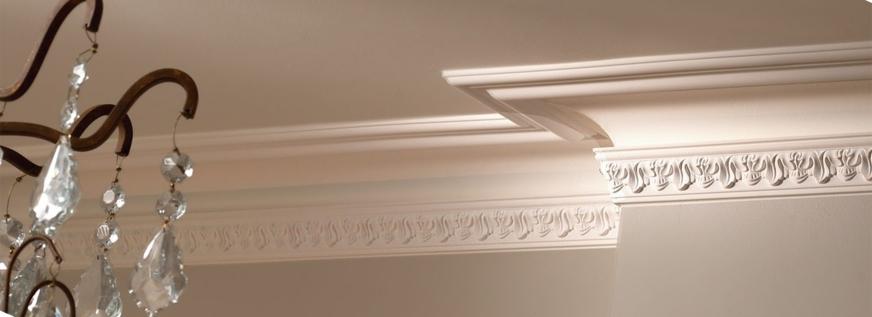
What is the difference between Ceiling Coving and Cornice?
Many people use the terms ceiling coving and cornice interchangeably, and in modern usage they are often treated as the same thing. However, there are some helpful distinctions.
What Is Ceiling Coving?
Coving usually refers to a simpler, more uniform ceiling moulding. It typically projects across the ceiling by roughly the same distance it drops down the wall. For example, a coving profile might measure 10 cm x 10 cm (projection x drop).
- Coving designs are generally plainer and more streamlined.
- Traditional coving often follows a quarter‑circle “C” profile, giving a smooth curved transition between wall and ceiling.
The Most Common Coving Profile
The most common coving size is the 5 inch (127 mm) cove. This dimension often causes confusion because it refers to an imaginary diagonal straight line drawn from the ceiling to the wall – not the actual ceiling projection or wall drop.
- A “127 mm cove” will have an 80 mm projection x 80 mm drop.
This plain cove became especially popular with post‑war house builders because it was simple, effective and affordable – and it remains one of the most widely fitted coving profiles in the UK.
What Is Cornice?
Cornice usually tends to describes a more decorative and often larger ceiling moulding. While a cornice can share similar overall dimensions to coving, it tends to be:
- More ornate in design
- Less uniform in the ratio of projection to drop
For example, a cornice might project 150 mm across the ceiling but drop only 100 mm down the wall (or the other way around). Cornice profiles often combine multiple curves and flat sections, reflecting different architectural styles and historical periods.
Traditional Plaster Coving and Cornice
Historically, both decorative coving and cornice were made from plaster, often reinforced with lime and hessian. While plaster can look beautiful, it has significant drawbacks:
- Very heavy and fragile to handle and transport
- Difficult to fix securely, as all the weight hangs from the ceiling
- Movement in walls or ceilings can cause cracks or even sections breaking away
In the 1970s, polystyrene coving became popular as a lightweight, cheap alternative. However, its poor visual quality and low‑grade appearance mean it is now generally avoided in higher‑quality homes.
Modern Coving Materials: Hardened Polyurethane
With modern technology, the industry standard for coving and cornice is now hardened polyurethane. This material combines the sharp detail of plaster with a range of practical benefits:
- Looks like high‑quality plaster but is lightweight and durable
- Best described as being like “light wood” in the way it cuts and handles
- Can be cut cleanly with a standard medium‑tooth crosscut saw, or an electric mitre / chop saw with an 80‑tooth blade
Installing Polyurethane Coving and Cornice
Polyurethane mouldings are designed to be easy to install:
- Their light weight means they can be fitted using adhesive only – no screws required
- They come with a pre‑applied primer/undercoat, ready for a final paint finish
- Joints can be made virtually invisible by using a small amount of Decofix Ultra joint adhesiveand FL300 filling compound, then finishing with your chosen paint
The end result is the appearance of traditional plaster cornice or coving, without the weight, fragility, or installation headaches.
If you’d like personal advice on choosing or installing ceiling coving or cornice, we’re happy to help.
Call us on 020 8660 2854 to discuss your requirements.